Helen Macdonald trains Mabel
H is for HawkHelen Macdonald trains Mabel by making attention, patience, and gradual familiarity the basis of their relationship. What begins as a carefully managed encounter with a frightened wild hawk becomes a reciprocal education: Macdonald learns to read Mabel’s changing responses, while Mabel encounters people and places without being treated as a creature that can simply be compelled into submission. The training also unsettles Macdonald’s inherited ideas about goshawks, exposes the social history behind falconry’s ranking of birds, and draws her into an intense process of watching shaped by grief.
From aversion to commitment
Before choosing to train a goshawk, Macdonald had long been uneasy around them. As a falconer she preferred falcons, admiring their speed, aerial skill, and apparent ease in flight. She associated goshawks with difficulty and death, and had absorbed a tradition of writing that described them as disagreeable, unruly, or frightening. Her decision to train Mabel therefore begins against a settled prejudice, not with an uncomplicated affinity for the species.
That prejudice had a social history as well as a personal one. Flying falcons properly required extensive open land, such as grouse moors and large estates, which were more accessible to wealthy or well-connected falconers. Goshawks, which could hunt after a short flight from the fist, were more practical in varied settings. Historical accounts consequently cast possession of the supposedly noble falcons as an aristocratic privilege, while the solitary trainers of goshawks and sparrowhawks received a poorer reputation. Macdonald connects the status of the bird to the status of the person who flew it: the hierarchy of falconry was not simply a judgment of flight, but also a judgment shaped by access to land and company.
The descriptions of female goshawks also become part of Macdonald’s reassessment. Later falconry books repeatedly characterize them as sulky, contrary, or difficult, often treating their behavior as an inherent defect. In contrast, seventeenth-century writers describe goshawks as shy but sociable and familiar, emphasizing that rough handling could provoke adverse responses and that kind treatment could foster trust. Macdonald finds in this contrast a different account of training: the bird’s conduct cannot be separated from the falconer’s behavior toward her. That historical reading prepares her to question whether Mabel’s actions confirm the old stereotypes or expose the limitations of the people who repeated them.
Establishing trust indoors
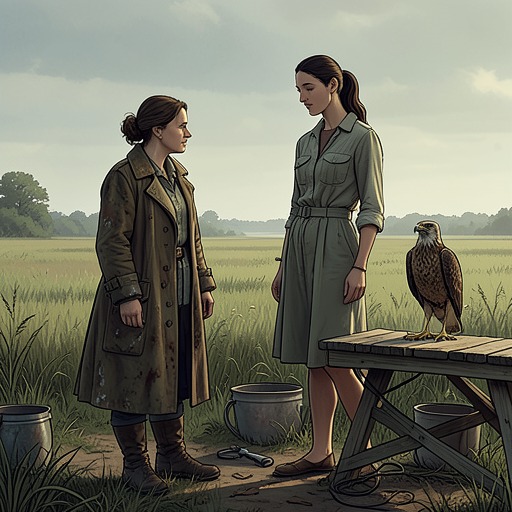
The first stage takes place in a dim room, where Mabel is hooded on her perch and Macdonald puts on a falconer’s glove before lifting her to her fist. The leash and falconer’s knot keep the hawk secured. When Mabel reacts by trying to leave the glove, Macdonald returns her to it gently and patiently. She also uses a modified set of scales to consider the hawk’s flying weight, since a bird that is too heavy may have little incentive to fly and one that is too light may lack the energy for strong flight. The practical routine depends on attending to Mabel’s physical condition as well as her behavior.
Macdonald places raw meat beneath Mabel’s feet and waits before removing the hood. The exposed hawk tries to get away, and the restraint of the jesses brings her back to the glove. Macdonald recognizes that, at this point, the bird is frightened by the very person hoping to become her partner. The training principle she follows is to make food, rather than punishment or force, the basis for a change in that response. Mabel must first attend to the food while Macdonald remains still and unobtrusive; only over time can the human presence become less alarming. In Macdonald’s account, this is not passive waiting alone but a disciplined effort to make herself less prominent in the hawk’s attention.
The practice of watching also connects to Macdonald’s own habits. As a child she had hidden beneath a rhododendron bush to observe the world from a sheltered place, finding safety in watching without being seen. She recognizes that this tendency to withdraw from participation can hinder human relationships, but, in the first days with a new hawk, it becomes a practical skill. She expects Mabel to feed from her fist, then gradually accept food from it, become accustomed to walks among unfamiliar surroundings, and eventually respond to a call, first on a creance and later in free flight. These are stages she anticipates, not a claim that they have already been achieved.
During the early indoor sessions, Macdonald shuts out distractions and spends long periods sitting with Mabel. She describes the old falconers’ term for this close familiarization as watching: sustained, careful attention to a bird’s condition. The room’s ordinary details—the curtained windows, books, old television, and perch—form a confined training environment in which even small movements matter. Macdonald notices Mabel gradually adopt a less tense stance, while remaining alert to how her own movements may affect the hawk. Waiting for Mabel to lower her head and begin feeding gives the sessions a precise immediate purpose.
Reading the hawk and changing the method
Macdonald treats Mabel’s posture and feathers as evidence of mood. Feathers held close to the body indicate fear; a looser posture suggests ease. Close observation brings subtler distinctions into view, and Macdonald becomes increasingly responsive to small changes in Mabel’s expression. She describes this as a form of practical prediction: the trainer learns not merely to watch the hawk but to anticipate what she may do next. The method depends on Mabel’s signals, rather than on a fixed schedule imposed without regard to her reactions.
That attention produces a powerful identification. Macdonald writes that she comes to apprehend the hawk’s surroundings and apprehensions so intensely that she feels herself changing. Her watchfulness is heightened by grief and by the effort not to be herself while attending to Mabel. This is a development in the training relationship, but it is not evidence that the two become interchangeable. Rather, the account shows how close observation can make another animal’s responses newly legible while also drawing the observer into an unstable sense of perspective.
Mabel’s first clear progress with food does not occur in the solitude Macdonald had expected. When Christina visits, Macdonald asks her to ignore the hawk and read the newspaper. Mabel remains in the room as the visitor turns its pages. Later, with Christina still present and the television on, Mabel eats from the meat beneath her feet. She then settles and rouses, a behavior Macdonald has not seen from her before and reads as a sign of contentment. The occasion revises Macdonald’s expectations: a new person and ordinary household activity have not prevented Mabel from feeding. The bird’s response is specific to what happens in the room, not a milestone produced according to Macdonald’s preferred script.
Mabel next begins taking small pieces of meat from the floor near her perch. Macdonald sends scraps toward her, and the hawk hops down to collect them before returning to the perch. This exchange expands the range of their interaction while keeping food central to the training. Mabel is not merely becoming accustomed to being handled; she is also responding to particular opportunities in her environment, and Macdonald adjusts her expectations to those choices.
From the house into shared space
After friends observe that Mabel is calmer, Stuart urges Macdonald to take her outdoors and accustom her to the streets. The next stage is carriage: walking with a hawk so that she can encounter changing surroundings while accompanied by the falconer. Historical falconry manuals had presented repeated carrying as essential, but Macdonald distinguishes gradual familiarization from simply exposing a bird to a succession of disturbances. She considers how the people, vehicles, and other moving objects encountered outside might appear to a hawk that has spent time indoors.
Macdonald’s reluctance to leave the house is not only concern for Mabel. She dreads being questioned and stared at, and acknowledges her own fear of people. She nevertheless takes Mabel first into the walled garden of her college house, where the hawk attends to clouds, a passing aircraft, insects, and food. The scene demonstrates a difference between human and hawk attention: Mabel’s visual world is organized by details that Macdonald would not have noticed without watching her.
In a later outdoor encounter, the hawk initially has to take in the traffic and movement around her. After some time she begins to eat. A woodpigeon then settles in a lime tree, and Mabel’s attention changes sharply as she tracks it. Macdonald recognizes that the hawk’s interests are not a human version of her own: the pigeon matters because it is potential quarry. This moment clarifies the limits of training as well as its possibilities. Familiarity may help Mabel tolerate a place, but it does not erase her independent perception as a hunting bird.
Macdonald makes gradual exposure a deliberate alternative to the approach T. H. White used with Gos. White took Gos out very soon after the hawk arrived and repeatedly brought him into busy settings, including a farmhouse, roads, a pub, and a motor car. Macdonald notes that Gos repeatedly bated on these outings and reads the practice as an education through unavoidable fear. Her own method is to move from enclosed rooms toward open air and to increase closeness to unfamiliar activity over days, rather than expecting the hawk to endure everything at once. The contrast turns training into a question of responsibility: the fact that a bird can be made to withstand disturbance does not, for Macdonald, make that disturbance a considerate way to teach.
Play, hunting, and the limits of taming
Mabel’s behavior also challenges the descriptions Macdonald had read. She plays with a strip of paper, taking it in her beak and returning to it, and responds to a rolled magazine when Macdonald looks at her through it. The exchange is specific and mutual: Mabel investigates the objects, repeats actions that interest her, and reacts to Macdonald’s participation. Macdonald is surprised because the books had not led her to expect play from a goshawk. She considers whether the absence of such descriptions reflects not the bird’s incapacity but the falconers’ failure to play with their hawks.
As training develops, Macdonald’s account gives Mabel agency without denying the constraints involved in keeping and training a wild bird. Mabel remains a creature people have captured and brought into their homes, yet she is not domesticated in the manner of animals adapted to close human company. That tension is central to Macdonald’s understanding of the relationship: training creates shared routines, but does not turn Mabel into a compliant human companion or reduce her to a symbol of Macdonald’s feelings.
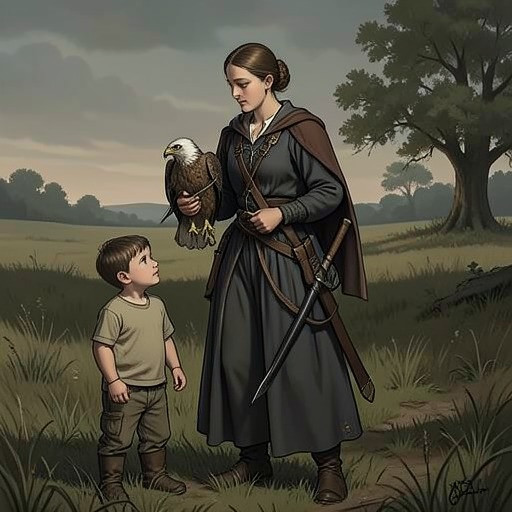
After her father’s death, Macdonald takes Mabel hawking and becomes involved in a pheasant hunt. When the pheasant disappears into a hedge, Macdonald searches for it while trying to infer Mabel’s position and actions. The effort to understand the hunt from both the ground and the hawk’s viewpoint produces a striking division in her sense of perspective. When the pheasant is flushed and Mabel flies toward it, the separated positions of hawk, quarry, and human become connected again in the immediate event. The hunt does not simply demonstrate a completed training program; it shows Macdonald participating in a shared action whose outcome she cannot control by observation alone.
The relationship continues beyond the first lessons in food and carriage. Macdonald makes Mabel toys from paper, tissue, and card; the hawk picks them up, drops them, and catches and tosses back balls of crumpled paper. Stuart doubts that goshawks play catch, but Macdonald has found that play helps leaven the emotional chill of her isolation. She contrasts her circumstances with those of other falconers, who can return from time with a hawk to family life and domestic routines. Macdonald feels that she has only the wildness and no corresponding domestic refuge. Against that imbalance, play offers a form of contact that is neither hunting nor mere handling, while leaving intact the difference between human need and the hawk’s independent life.